

The Thread Group has approved work to bring its open, IP-based mesh networking protocol down to the Sub-GHz spectrum. While Thread currently runs on the standard 2.4 GHz band using IEEE 802.15.4 radios, expanding into lower frequencies addresses long-standing range and signal penetration limits that plague crowded wireless environments.
Commercial and industrial markets rely heavily on proprietary Sub-GHz solutions for long-distance connectivity. By introducing a standardized Sub-GHz physical layer (PHY), the organization aims to unify these two markets under a single open framework.
Breaking Free From 2.4 GHz
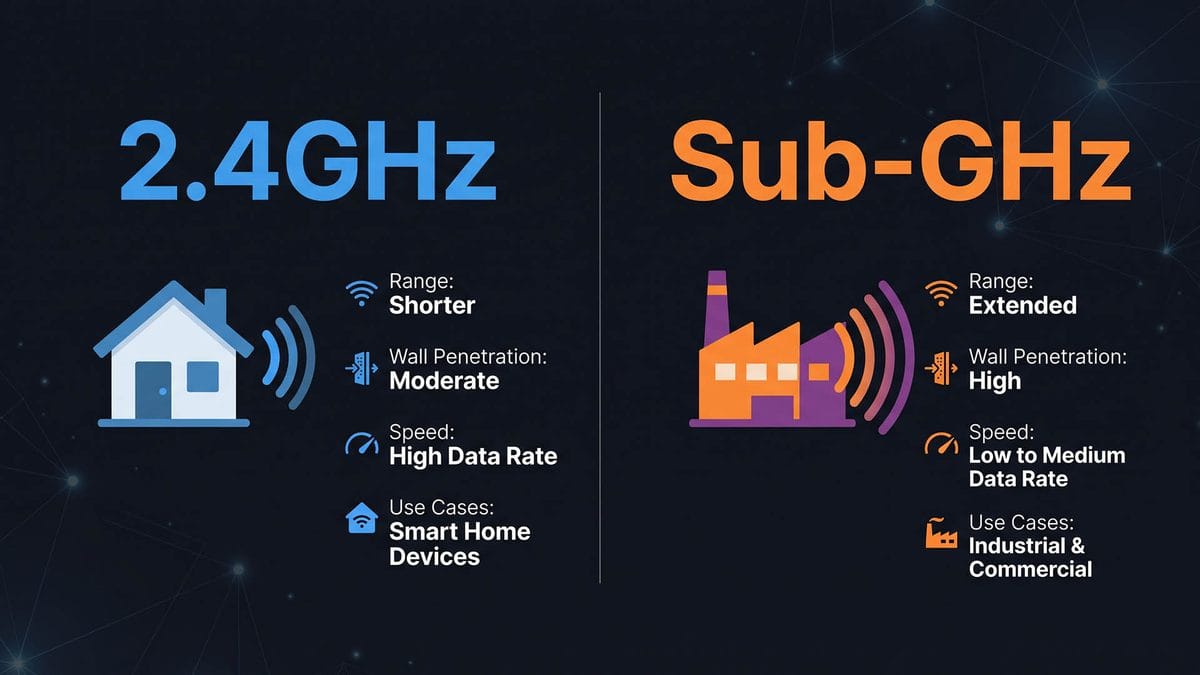
The 2.4 GHz spectrum has become notoriously congested over the years. Between dense Wi-Fi networks, Bluetooth accessories, and domestic appliances, low-power mesh radios frequently face severe radio frequency interference. Signals in this band also struggle to pass through heavy concrete walls, dense metal structures, and long physical distances.
Sub-GHz frequencies operate below 1 GHz, typically using bands around 868 MHz in Europe or 915 MHz in the Americas. Lower frequencies feature much longer wavelengths, enabling wireless signals to bend around physical obstacles, penetrate thick building walls, and travel significantly farther than 2.4 GHz signals. Bringing Thread’s native IPv6 routing and mesh capabilities to these lower bands allows large-scale installations to cover large properties without needing an excessive number of routing nodes to bridge gaps.
Industrial and Commercial Network Fragmentation
Industrial automation, healthcare facilities, and building management systems have traditionally depended on Sub-GHz radios to connect distant sensors and lighting controls. However, because those deployments relied on proprietary or non-standard protocols, hardware options remained locked into closed vendor ecosystems.
Thread’s upcoming Sub-GHz implementation provides a standardized, interoperable alternative built on the same consensus-driven process behind its existing specifications. Because Thread operates directly on IP standards, devices running on Sub-GHz radios can communicate seamlessly across existing local networks without relying on complex, failure-prone custom translation gateways.
The organization plans to unveil distinct branding for this Sub-GHz technology over the coming months as development continues alongside ecosystem members.
What This Means for Future Smart Home Expansion
While the initial focus of the Sub-GHz expansion centers on commercial and industrial IoT, the long-term benefits for broader smart home deployments are hard to ignore. Protocols like Z-Wave have maintained a strong foothold in smart home security and outdoor setups precisely because their Sub-GHz radios effortlessly reach outbuildings, detached garages, and outdoor gates.
If application layers like Matter eventually adopt Sub-GHz Thread transports, we could see an end to dropped connections on garden sensors, perimeter lighting, and outdoor locks. Unifying long-range outdoor devices with high-speed indoor mesh nodes under a single IPv6 framework is a welcome shift for anyone building a reliable, large-scale smart home.